 Loire Valley Castles Tour
Château de Chenonceau: the Castle Over the Water
Château de Chenonceau stands on arches over the River Cher, and it is France's second most visited château after Versailles. This guide covers the hours, the ticket options, the train from Tours, and the rooms, gardens and war history inside. If you would rather let someone else drive, the Loire Valley castle tours include skip-the-line days from Paris and small-group days from Tours. The page stays on Chenonceau itself. Chambord, Amboise, Villandry and the rest each have their own guide.
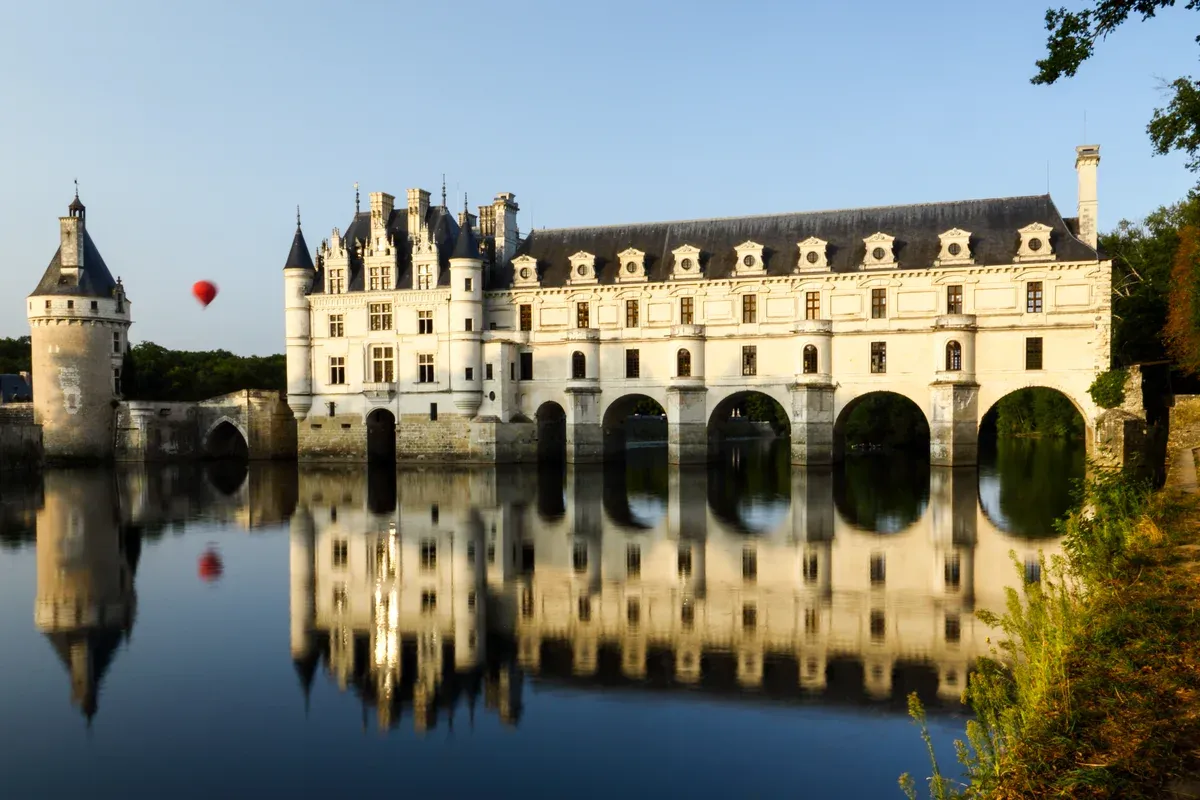
The arched gallery of Chenonceau reflected in the Cher at dusk. Photo: Adriano Russo, CC BY-SA 4.0, via Wikimedia Commons
Quick answer Chenonceau in brief
Château de Chenonceau opens every day of the year, from 9:00 or 9:30 depending on the season, with July and August running 9:00 to 19:00. The site has been owned by the Menier chocolate family since 1913 and holds France's second highest castle attendance after Versailles. The dated entry ticket is booked through the entry ticket further down this page.
Key takeaways
- Travel light on logistics: the TER train from Tours takes 25 minutes and Chenonceaux station is 400 metres from the ticket office. Details in the visiting section.
- Short on time? The pick for a guided day is the Chenonceau and Chambord tour from Tours, with tickets and a licensed guide at both castles.
- Coming from Paris, a coach day such as the Loire Valley Castles Day Trip with Wine Tasting covers Chambord and Chenonceau in one go.
- The walk order matters. Follow the what to see section from the keep through the Grand Gallery and out into the two rival gardens.
Visiting Chenonceau: Hours, Tickets and Time
Chenonceau never closes for a weekly rest day, so the real planning questions are season, transport and how long to stay. The figures below come from the château's own practical pages.
Practical Facts at a Glance
The château states that it is open every day of the year, château and gardens together. Opening hours shift with the season and closing times vary within a season too, so the table gives the ranges the château publishes. Entry is by dated ticket, which you book through the entry ticket further down this page, and the château shows wait times to e-ticket holders on busy weekends. The basic entry ticket is $21 with a 4.7 rating from 1,852 reviews. Children under 7 enter free, and audioguides are not available for them. You can also combine the visit: the Pass Châteaux 'The Essentials' covers Chambord, Chenonceau and Amboise for one adult, valid for 10 consecutive days from first entry, with no skip-the-line and audioguides extra.
Getting there is easy without a car. From Paris, the château's own route note is a TGV from Paris Montparnasse to Saint-Pierre-des-Corps of about 1 hour, then the TER Tours to Chenonceaux in 25 minutes, and the station sits about 400 metres from the ticket office. By car from Paris it is about 2 hours via the A10, exiting at Blois or Amboise. The estate is 214 km from Paris and 34 km from Tours. For a full comparison of routes from the capital, see Paris to Loire Valley.
| What | Detail |
|---|---|
| Opening days | Every day of the year, château and gardens |
| Winter hours (January to March, November, December) | Opens 9:30, closes between 16:30 and 18:30 depending on the period |
| April, September, October | Opens 9:00, closes 17:30 to 18:00 |
| July and August | 9:00 to 19:00, same summer hours on some bank-holiday weekends such as Easter, May Day, Ascension and Pentecost |
| Closing days | None stated by the château |
| How long to allow | The château states no visit length. The park covers 70 hectares |
| By train | TGV Paris Montparnasse to Saint-Pierre-des-Corps about 1 hour, then TER Tours to Chenonceaux in 25 minutes |
| Station to ticket office | About 400 metres on foot |
| By car from Paris | About 2 hours via the A10, exit at Blois or Amboise |
| Distances | 214 km from Paris, 34 km from Tours |
| Parking | Parking reserved for campers, bicycles and motorbikes, plus three free Tesla charging terminals including a universal type 2 |
| Tickets | Dated entry ticket booked through the entry ticket below, $21, children under 7 free |
When to Go, and What Changes by Season
July and August give you the longest hours, 9:00 to 19:00, plus the summer extras: the château holds the Jardin remarquable label and runs night garden walks and boat outings in that season. They are also the busiest months, which is when the e-ticket wait-time display matters most. Spring and autumn run 9:00 to 17:30 or 18:00, and winter opens at 9:30 with early closes, which suits a short daylight visit.
Tours, 34 km away, averages a daily high of 7.7 C in January and 26.0 C in August, with the wettest months from October to December and the driest in July and August. That makes late spring and early autumn the comfortable middle ground.
Winter has its own draw: the Christmas floral display runs from Saint Nicholas Day on 6 December to Epiphany on 6 January, and the château holds an evening opening on 23 December during the Christmas season. Every room is decorated with flowers by the on-site floral workshop.
The free rules are short. Children under 7 enter free, and they cannot use the audioguides. No other free-entry rule is stated on the château's practical pages, so everyone else buys a ticket, either the dated single entry or a pass such as the Chambord-Cheverny-Chenonceau pass, valid throughout 2026.
- Summer: longest hours, night garden walks, boat outings, biggest crowds
- Spring and autumn: 9:00 openings, mild weather, thinner crowds than July
- Winter: 9:30 openings, early closes, the Christmas floral display from 6 December to 6 January
What to See, in Visiting Order
You enter through the old gatehouse complex, walk the château from the medieval keep to the gallery over the river, then finish outside among the gardens. Here is the sequence, block by block.
The Tour Des Marques, the Medieval Keep
Before the château you see stands the Tour des Marques, the one survivor of the first medieval castle on the site, which dated from the 12th and 13th centuries. Thomas Bohier bought the estate from Pierre Marques in 1513, demolished most of the old building and kept this 15th-century keep standing. According to the château, he and above all his wife Catherine Briçonnet built the present château between 1513 and 1517.
Covered and open picnic areas sit beside the moat, at the château entrance and by the green car park.
The State Rooms and the Chambers of the Women
Inside, the château tells the story its owners call an almost uninterrupted succession of women. Diane de Poitiers received the castle from King Henri II, a gift that took it out of the Crown lands and later saved it from the Revolution. Catherine de' Medici took it from her on 10 July 1559 and governed the kingdom from her study, the Green Cabinet.
Louise de Lorraine, widow of Henri III, withdrew here in mourning. The interiors include a chamber of Diane de Poitiers, a chamber of François I and a chamber of Catherine de' Medici. Keep the free Discover Chenonceau app on your phone as you move through the rooms, on your phone.
The Grand Gallery Over the Cher
This is the room the château is famous for. The bridge across the river was built from 1556 to 1559 by Philibert de l'Orme, and the grand gallery on top of it was added from 1570 to 1576 to designs by Jean Bullant and dedicated in 1577. The gallery and its arches span the River Cher, so you walk the length of a room standing on water.
In World War I the gallery served as a hospital ward. In World War II it was the only crossing point into the free zone, and the Menier family used it to help people flee, while the château itself was bombed by the Germans in June 1940 and by the Allies on 7 June 1944. Few rooms in France carry that much history in one line of sight.
The Art Collection
The rooms are hung with old masters, and the collection includes works attributed to Rubens, Primaticcio, Tintoretto, Murillo, Veronese, Poussin and Van Dyck. There is also a Florentine sculpture by Mino da Fiesole from the 15th century. The château first opened to visitors in 1913, the same year Henri Menier bought it from the Crédit Foncier, and US president Harry Truman visited on his first trip to France.
The Apothecary and the Cabinet Des Sciences
In the Dômes building, the former royal stables, you find two modern additions with old roots. Catherine de' Medici's apothecary was recreated identically there and opened on 15 June 2019, and the Cabinet des Sciences opened in the same building on 15 June 2024. They sit in the same complex as the self-service restaurant, which is open daily from mid-March to mid-November, and the Caves des Dômes, the château's historic wine cellar with a 16th-century vaulted ceiling and wine tastings, also running mid-March to mid-November.
This is the natural lunch stop, and a crêperie stands near the car parks just before the ticket office.
The Garden of Diane de Poitiers
You step out of the château straight onto the gardens, and the larger one belongs to Diane de Poitiers. It covers 12,000 square metres, a floating parterre redesigned by Achille Duchêne, and its position against the river bank is what gives the château its postcard angle. The garden's history is not all smooth: the Cher flood of 7 May 1940 devastated it, and what you see now is the restored layout.
The Garden of Catherine De' Medici
Across the château from Diane's garden lies the smaller rival, laid out for Catherine de' Medici. It covers about 5,000 to 5,500 square metres, depending on the source, and faces the lake and the park. Between the two, the flower garden has twelve squares bordered by apple trees and Queen Elisabeth roses, grows about one hundred cutting-flower varieties and holds more than 400 roses, all cut and arranged by the château's floral workshop, run for over 20 years by two flower experts with a head florist holding the Meilleur Ouvrier de France title.
The Maze, the Green Garden and the Park
Finish on foot in the 70-hectare park. The Italian maze stands here, planted with 2,000 yew trees and covering over a hectare, with a raised gazebo at its centre that gives a view over the whole pattern. The Green Garden nearby was designed by Lord Seymour in 1825 for the Countess of Villeneuve in the English style, so it feels deliberately looser than the formal parterres.
Families with small children can detour to the Musical Garden, which has xylophone animals and drum turrets. Dogs are welcome in the grounds on a lead, and small dogs must be carried inside the château, with guide dogs accepted everywhere. Free lockers let you drop bags before the walk.
Chateau CHENONCEAU -- Tour the Ultimate FAIRYTALE CASTLE -- Loire Valley, France
A visit to Chenonceau showing the arched gallery over the Cher and the rooms inside. Third-party video by Chateau Love. This site did not shoot it and has no relationship with the creator.
A Short History of Chenonceau
The château calls its past an almost uninterrupted succession of women, and the phrase fits. This short history gives the builders, the residents and the dates, all drawn from the château's own pages and encyclopedic sources.
From a Medieval Keep to the River Bridge
A first château stood here in the 12th and 13th centuries. Only its keep, the Tour des Marques, survives. In 1513 Thomas Bohier bought the estate from Pierre Marques, demolished most of what stood there and left the old keep in place. Between 1513 and 1517 the present château rose, built by Bohier and above all his wife Catherine Briçonnet, whose role the château itself underlines.
The next step went over the water. Philibert de l'Orme built the bridge across the River Cher from 1556 to 1559, and from 1570 to 1576 Jean Bullant designed the grand gallery that now spans it. The gallery was dedicated in 1577. Two construction dates coexist in the sources: the château gives 1513 to 1517 for the main build, while English Wikipedia passages give 1514 to 1522.
| Year | What happened |
|---|---|
| 1513 | Thomas Bohier buys Chenonceau from Pierre Marques and starts the new château with Catherine Briçonnet |
| 1517 | The present château, built 1513 to 1517, is complete |
| 1556-1559 | Philibert de l'Orme builds the bridge over the Cher |
| 1559 | Catherine de' Medici takes the château from Diane de Poitiers |
| 1560 | The first fireworks display seen in France is held at Chenonceau |
| 1570-1576 | Jean Bullant's grand gallery is built over the bridge |
| 1864 | Marguerite Pelouze buys the château |
| 1913 | Henri Menier buys Chenonceau and it opens to visitors |
| 1940 and 1944 | The château is bombed by the Germans and then by the Allies |
| 2019 and 2024 | The recreated apothecary and then the Cabinet des Sciences open in the Dômes building |
The Women Who Ran It
King Henri II gave Chenonceau to his favourite Diane de Poitiers, a gift that took the estate out of the Crown lands. That status later saved it from the Revolution. On 10 July 1559 Catherine de' Medici took the château from Diane and went on to govern the kingdom from her study here, the Green Cabinet. Louise de Lorraine, widow of Henri III, withdrew to Chenonceau in mourning.
In the 18th century Louise Dupin ran a literary salon at the château, and Jean-Jacques Rousseau worked there as her secretary. According to the château, she drafted a Code of Women's Rights with his help. Marguerite Pelouze bought the property in 1864, and architect Félix Roguet restored it around 1875. On his first trip to France, US president Harry Truman visited Chenonceau.
War Years and the Menier Family
The Menier chocolate family has owned Chenonceau since 1913, the year the château first opened to visitors. During World War I Gaston Menier turned it into a military hospital, and the gallery over the river served as a hospital ward.
In World War II the château stood on the line between occupied and free France. The Grand Gallery was the only crossing point into the free zone, and the Menier family helped people flee. The château paid a price: it was bombed by the Germans in June 1940, and the Cher flood of 7 May 1940 devastated Diane's garden, before Allied bombing on 7 June 1944.
The Art Collection
Inside, the château holds works attributed to Rubens, Primaticcio, Tintoretto, Murillo, Veronese, Poussin and Van Dyck, plus a Florentine sculpture by Mino da Fiesole from the 15th century. French Wikipedia also lists chambers named after Diane de Poitiers, François I and Catherine de' Medici. A free visitor app called Discover Chenonceau covers the visit.
If you prefer a guide, the small-group day from Tours, the Chenonceau and Chambord day trip from Tours, includes a guided visit inside Chenonceau.
Sources: Chenonceau history and Wikipedia
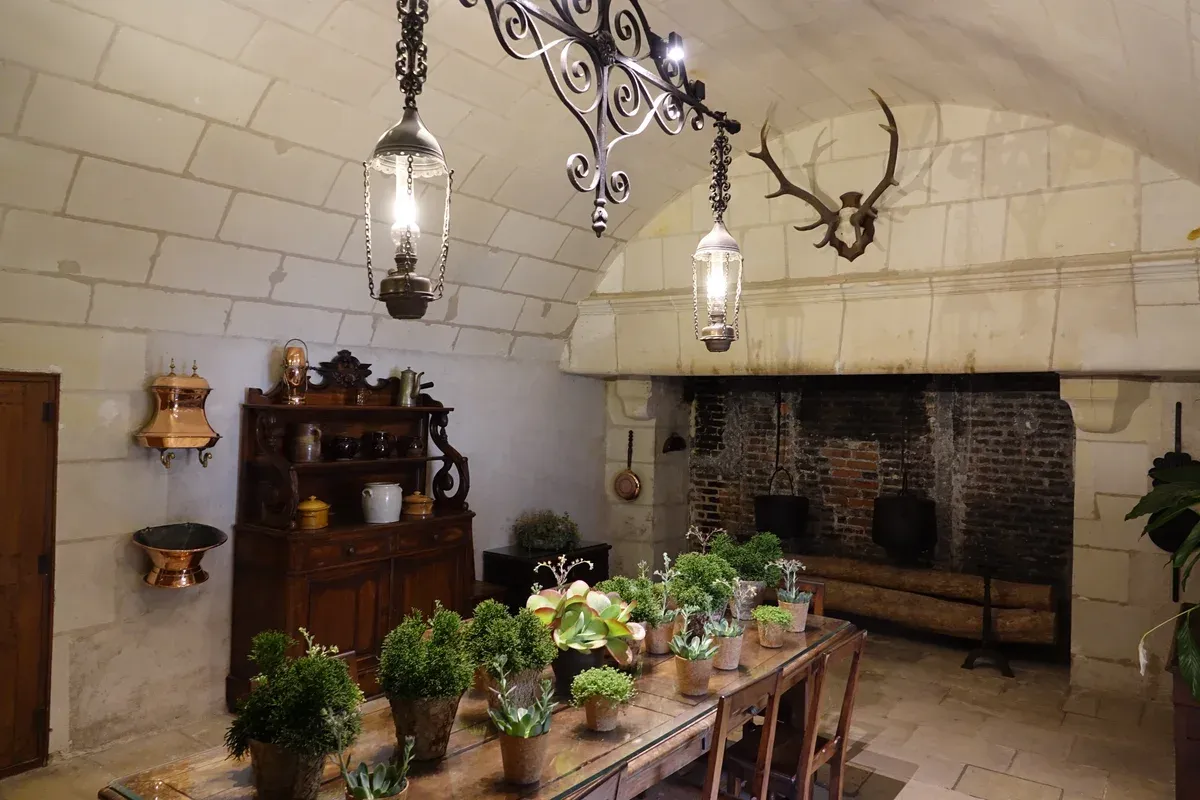
The vaulted stone kitchen at Chenonceau with its copper pans, hanging lamps and flower pots. Photo: Gzen92, CC BY-SA 4.0, via Wikimedia Commons
Getting There Without a Car, and With One
Chenonceau is one of the easiest Loire châteaux to reach by train. The figures here come from the château's own access page and the regional tourist boards.
By Train from Paris or Tours
The route from Paris runs by TGV from Paris Montparnasse to Saint-Pierre-des-Corps, about 1 hour, then the TER Tours line to the Chenonceaux station in 25 minutes. That station is about 400 metres from the château ticket office, so the walk is short and flat.
Chenonceau sits 214 km from Paris and 34 km from Tours. If you base yourself in Tours, regional trains also connect Amboise, Chenonceau and Chinon on the same network. All Rémi trains take bicycles on board, which makes a bike-and-train day possible. For the wider rail picture, see Paris to Loire Valley by train.
By Bike
Cyclists have two reported distances between Amboise and Chenonceau, and they differ. France Vélo Tourisme's Loire à Vélo stage sheet gives about 12 km via the D81 and D40, while the Amboise tourist office gives about 20 km direct and 45 km on loop 47. Both come from official sources, so check your route before you set out.
The general rule of thumb around Blois is that the castles there sit 15 to 20 km apart.
By Car
The château puts the drive from Paris at about 2 hours via the A10, exiting at Blois or Amboise. The Touraine tourist board puts Tours at about 238 km from Paris by road, which helps place the region. Chenonceau has parking reserved for campers, bicycles and motorbikes, and three free Tesla charging terminals including a universal type 2 terminal.
Sources: Chenonceau access and Touraine tourist board
Seeing Chenonceau on a Tour
Nine bookable tours in the Loire Valley castles tour comparison enter Chenonceau, from Paris, Tours and Amboise. Prices are per person as listed, and entry is inside the price unless noted.
Which Tours Include It
From Paris, the Loire Valley castles day trip with wine tasting is a $115 coach day of 12.5-13 hours with skip-the-line entry to Chambord and Chenonceau plus a wine tasting in the Chenonceau cellar for current bookings. The full-day chateaux tour from Paris is the lowest-priced Paris departure at $101 for 13 hours, though the licensed guide and audio guide depend on the option you pick. The small-group wine and castles day costs $280 in a van of 8 at most with entry to Chenonceau, Chambord and Amboise.
The three-castle tour with entry tickets costs $237, lists hotel pickup depending on the option and includes tickets to three castles and their gardens. The small-group tour with lunch in Amboise costs $376, but its listing does not name castle entry as included, so check with the operator before booking. The private VIP day at $874 includes hotel pickup and all fees and taxes, but castle entrance tickets are not named separately. Lunch is not included on the $237 and $874 days, while the $376 day includes a sit-down lunch in Amboise.
From Tours and Amboise the days are shorter. The Chenonceau and Chambord day trip from Tours and Amboise costs $231 over 9 hours with entry tickets and guided visits at both castles. The Ophorus day to Chenonceau and Chambord costs $240 over 8 hours with tickets and guided visits. From Amboise, the tour with lunch at a chateau costs $268 over 8.5 hours, with entrance fees included and lunch at Villesavin.
Prices at a Glance
The table lists every tour that enters Chenonceau, with its listed price, departure city and whether castle entry is in the price. Figures come from the tour listings.
| Tour | Price | Leaves from | Entry in price |
|---|---|---|---|
| Loire Valley Castles Day Trip with Wine Tasting | $115 | Paris | Yes, skip-the-line |
| Full-Day Loire Valley Chateaux Tour | $101 | Paris | Yes, guide by option |
| Small-Group Wine and Castles Day Trip | $280 | Paris | Yes, three castles |
| Three Castles Tour with Entry Tickets | $237 | Paris | Yes, castles and gardens |
| Small-Group Tour with Lunch in Amboise | $376 | Paris | Not stated, ask operator |
| VIP Private Tour Chambord, Chenonceaux, Amboise | $874 | Paris | Fees and taxes included, tickets not named |
| Chenonceau and Chambord Day Trip from Tours and Amboise | $231 | Tours or Amboise | Yes, with guided visit |
| Day Tour to Chenonceau and Chambord Castles | $240 | Tours | Yes, with guided visit |
| Chambord and Chenonceau Tour with Lunch from Amboise | $268 | Amboise | Yes |
Dos and Don'ts at Chenonceau
Do
- Do book a dated e-ticket in advance, because the château shows e-ticket holders their wait time on busy weekends and the site is France's second most visited château after Versailles.
- Do plan around the seasonal hours, since opening runs 9:30 to between 16:30 and 18:30 in winter, 9:00 to 17:30 or 18:00 in April, September and October, and 9:00 to 19:00 in July and August.
- Do leave time for the 70-hectare park, because the Italian maze of 2,000 yew trees and the 12,000 square metre Diane de Poitiers garden are part of the same ticket.
- Do pick up the free Discover Chenonceau app, since children under 7 get free entry but no audioguide and the app covers the visit at no cost.
- Do bring the dog and use the picnic areas by the moat, as dogs on a lead are welcome in the grounds, small dogs can be carried inside, and covered and open picnic areas sit at the entrance and by the green car park.
Don't
- Don't bring a group audioguide without reserving, because group audioguides must be reserved and are unavailable in July and August.
- Don't count on the self-service restaurant in winter, since it opens daily only from mid-March to mid-November, though the crêperie near the car parks is an alternative.
- Don't skip the Dômes building, because the recreated apothecary opened there in 2019 and the Cabinet des Sciences followed in 2024.
- Don't rely on a single bike-distance figure, since official sources disagree on Amboise to Chenonceau, giving about 12 km on one stage sheet and about 20 km direct on another.
Book the Entry Ticket
A dated e-ticket is the one thing to sort before the day if you visit without a tour. The price is the lowest adult rate on the booking page, and free-entry rules still apply at the gate where the chateau offers them.
Ticket and Price
The table lists the entry ticket for this chateau with its starting price and the rating travellers gave it on the booking page. Prices change by date and option, so the final figure shows at checkout.
| Ticket | Price | Rating | Book |
|---|---|---|---|
| Château de Chenonceau | from $21 | 4.7 from 1,852 reviews | Check Availability |
Questions About Chenonceau
What is the Château de Chenonceau famous for?
It is famous for the gallery and arches that span the River Cher, for its line of women owners from Catherine Briçonnet to Catherine de' Medici, and for its role as a hospital ward in World War I and a crossing point between occupied and free France in World War II. The château one by one covers the visit in detail.
Who owns the Château de Chenonceau now?
The Menier chocolate family has owned the château since 1913, when Henri Menier bought it from the Crédit Foncier. The family turned it into a military hospital in World War I and helped people flee across the gallery in World War II. See the short history above.
Do you need tickets for Château de Chenonceau?
Yes, entry to the château and gardens is ticketed, though children under 7 enter free and their audioguides are not available. The dated entry ticket is booked through the entry ticket further down the page.
How do I get to Chenonceau from Tours without a car?
Take the TER train from Tours to the Chenonceaux station, a 25-minute ride, and the station is about 400 metres from the château ticket office. Paris to Loire Valley by train sets out the wider rail options.
Which tours from Paris include Chenonceau?
Several coach and minivan days from Paris enter the château, from a $101 coach day to a $874 private day, most with entry included in the price. Loire Valley castle tours compares them all in one table.
Is Chenonceau good for families?
Children under 7 enter free, the Musical Garden has xylophone animals and drum turrets, and the maze of 2,000 yew trees has a raised gazebo with a view over the whole layout. For other family stops nearby, see Amboise France.